


There’s a man in a Lisbon café who has no idea he rearranged my life.
We were talking about coffee. That’s it. Coffee, travel, his theory that October light hits Lisbon differently, delivered with the confidence of a man who has watched a lot of Octobers. And then, somewhere between refills, he set his cup down and said something that had nothing to do with anything:
“If everything you offered wasn’t enough... offer your absence. Salt isn’t on the menu. But when it’s missing, you feel it.”
I had no idea what to do with that… so I did what any reasonable, good girl mid unraveling does: I wrote it in my journal in the prettiest handwriting, ordered another coffee like a pro, and sat with it while pretending I was simply a person enjoying a beverage when deep down, I knew that the universe has never been subtle with me. That one felt personal.
To explain why, I have to back up about seven hundred years. Nope, not kidding.
The queen they crowned anyway
In the 1300s, a Portuguese prince fell in love with a woman named Inês de Castro. Loudly. Completely. The sort of love that rearranges things. But Inês was inconvenient... politically, socially, strategically. So while the prince was away, they killed her.
That should have been the end of the story.
When he became king, he refused to accept it. He had her body exhumed. Dressed her in royal robes. Sat her on a throne and crowned her Queen of Portugal. And then he made the entire court line up, one by one, and kiss her hand. As if loyalty could override reality. As if devotion could bring something back. As if pretending hard enough would make it true.
The Portuguese still have a saying that grew out of that story. Inês é morta. Inês is dead. It’s what you say when something has already ended and someone is still sitting at the table, negotiating with it.
I heard that story my first night in Lisbon and couldn’t stop turning it over. And here’s the part I never said out loud to anyone at that dinner: I recognized myself in it.
Not as Inês. Not as the king.
As the court.
The part of me that lines up. The part that participates. The part that knows something is over and keeps kissing its hand anyway.
The trip that was supposed to be a “we”
A confession before we go further: Portugal was never planned as a solo trip. He was supposed to be there. We’d planned it, booked it, imagined it. Then we broke up. Again. Right before I left.
I went anyway. The plan was to film beautiful things, eat well, walk slowly, collect moments. And I did those things, technically. But I kept standing in places that should have moved me and feeling... nothing. I told myself it would shift tomorrow. After I adjust. After I settle in.
It didn’t. And that unsettled me more than any fight ever had.
Because there was no chaos to point at. No screaming matches, no obvious breaking point. Just something off, humming underneath everything, asking nothing of me except that I tolerate it.
Isn’t that the place we stay in the longest? The one that never demands a decision?
You get good at it, too.
It’s fine. I’m working through it. It just needs more time.
Different conversations, same outcome. And somewhere underneath all of it... you know. You knew.
What my body was calling love
Here’s what I hadn’t understood yet, and I say this as someone who later went and studied attachment professionally, which makes the whole thing either ironic or inevitable:
I had spent years confusing chaos with love. Calm read as distance. The absence of turbulence felt like a warning instead of what it actually was... a gift.
My nervous system had decided that intensity was connection. That the tightness in my chest was passion. That constantly adjusting my tone, measuring my words, and scanning the room for his mood was just what loving someone well looked like.
Except love doesn’t ask you to run surveillance. That was my body doing what bodies do when they conclude that chaos is the price of being kept.
And fear is creative. Hope is persuasive. A nervous system will normalize nearly anything it believes will keep you safe, even the very thing wearing you down. Because your body doesn’t choose what’s healthy. It chooses what it recognizes. I’d spent enough years inside the cycle that mine had filed that particular weight under “home.”
I wasn’t being loyal. I was abandoning myself and calling it devotion.
There’s a place in Portugal called Cabo da Roca. The edge of the continent. You stand there and there’s nothing in front of you but ocean. No distractions. No noise to hide behind.
Standing there, at the edge of Europe, something asked me a question I wasn’t ready for:
Who would you be in the absence of your concerns? Not the roles. Not the history. Not the version of you that exists in relation to the problem. Just you.
I didn’t have an answer. But I couldn’t unfeel the question.
I watched the cliffs for a long time. The water throws everything it has at them, every single day, and they remain themselves. They don’t negotiate with the ocean. And I realized I had spent years asking someone to stop being the ocean …basically asking the water to be still… and I called it patience. It was denial.
Familiar and safe are different things. Familiar and peace are different things. And once you feel that difference in your body, you stop trying to argue yourself into clarity.
Strangers who never asked for the backstory
Somewhere in that week, without planning it, people found me. A food tour through Lisbon that turned a table of strangers into a table of friends. A guy at a bar who turned out to be staying on my same floor, which is the universe showing off. New Portuguese friends who pulled me in knowing nothing about what I was carrying. No context. No explanations required.
They took me exactly as I showed up. Unguarded. A little raw. Entirely myself. None of them knew a single thing about my personal world, and somehow that made it the most seen I’d felt in years.
It caught me off guard, that gratitude. I’d almost forgotten I was allowed to feel it. And listen, I’m an introvert. Life refusing to stop handing me my people just because something ended... well, I wasn’t about to take that for granted.
The text
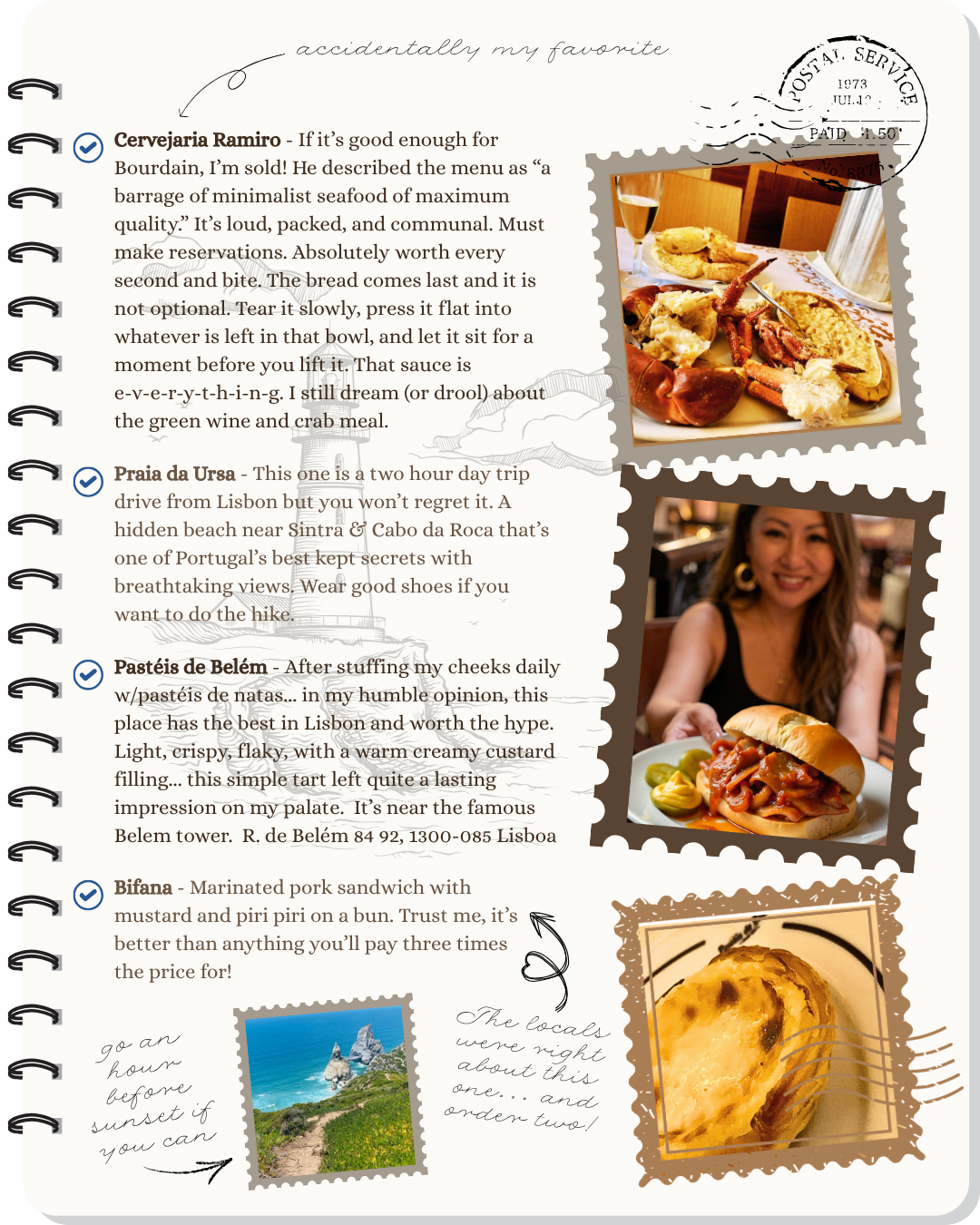
My last night in Portugal, I chose to spend alone. Well. Alone with pastéis de nata, which is a different thing entirely.
My phone lit up. His name.
You know the feeling. I don’t have to describe it. The pull. The drop. The instinct that moves before the brain does. And for a moment I almost leaned back in. Internally, I mean, because that’s how it works. You don’t go back all at once. You lean. Then you lean a little more.
And something in me paused. No speech. No drama. I just... didn’t open it.
I stayed exactly where I was, in a moment asking nothing of me except to be in it. Custard, cinnamon, a warm night in Belém. And that’s when the salt line finally landed. The café oracle was right. If everything you offered wasn’t enough... offer your absence.
The text stayed unread for three days. By the time I opened it, it didn’t matter anymore. I had already chosen.
Inês é morta
I keep coming back to that day at the edge of Europe, nothing in front of me but ocean, when I finally whispered the answer back.
Inês é morta.
And it didn’t land as grief. It didn’t land as punishment or some heavy verdict from the universe. It landed as relief. A door finally closing so my hands and heart could be free.
It was already over. Stop crowning it. Stop dressing it up. Stop commanding yourself to bow. The ending was never the wasted time. The performance was.
I flew to Portugal carrying a future that no longer had my name on it. I didn’t know that while I was packing. Didn’t know it booking the flights, imagining the streets, picturing a version of the trip I’d built inside something I was still trying to resurrect. I brought all of it with me. The hope. The timeline.
I carried that future all the way to the literal edge of a continent.
But I came home without it y’all. Nobody took it from me. I set it down. On that cliff, on that day. And for the first time in a very long time, my hands were empty in the best possible way.
So if you’re somewhere in your own version of this... in something that doesn’t feel right but doesn’t feel bad enough to leave... notice what you’ve been calling peace. Ask whether it actually feels like peace or whether it just feels familiar. Trust that your body knows the difference. It’s been likely trying to tell you in a language you were taught to talk over.
And if you’re carrying a future that belongs to a version of someone who hasn’t shown up yet, notice the weight of it. Just notice..
Salt’s never on the menu. But when it’s missing, you feel it.
With Love Always,

PS. I still have the journal. The salt line has its own page now, no neighbors. Some sentences truly do deserve the whole room, don’tcha think? ; )
Field Notes
A few things worth taking home.
A little excerpt from the letter I wrote in Portugal, now sealed and making its way to
Lounge 143 members’ mailboxes:
“...I wondered if we spend too much time looking for light from somewhere else, forgetting we might already be carrying it...”
The rest is on paper, where it belongs.